How to Read a Crochet Pattern for Beginners
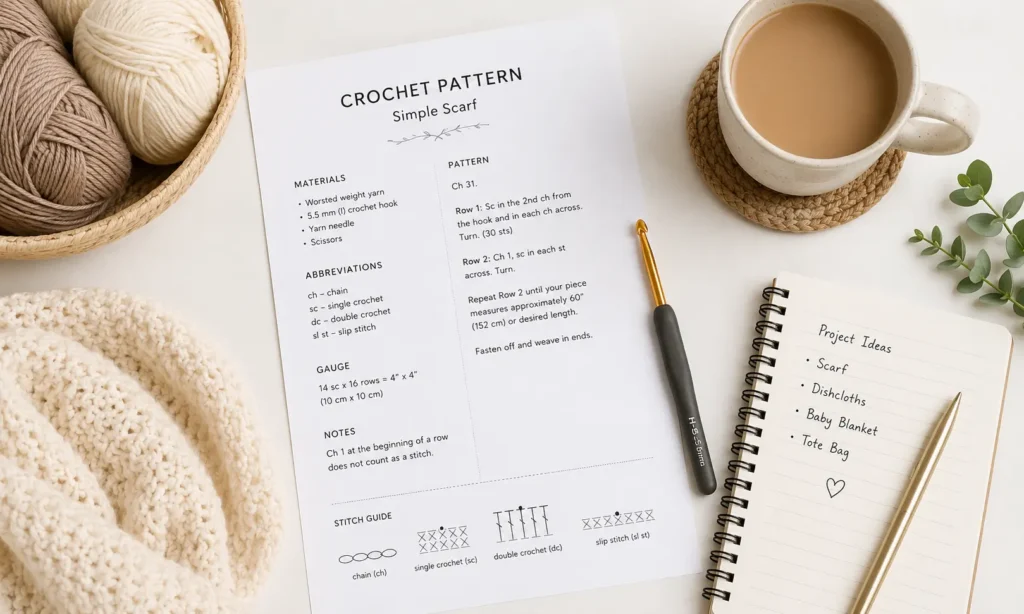
Reading a crochet pattern for the first time can feel a little overwhelming.
When you first open a crochet pattern, it can feel like a mix of abbreviations, numbers, and symbols. This guide breaks it down slowly, using a very simple dishcloth-style example so each part is easier to understand.
The good news is that crochet patterns are much easier to understand once you know how they are organized. Most patterns follow a similar structure, and after you learn the basic parts, you will start to recognize them again and again.
In this beginner guide, we’ll go through the main sections of a crochet pattern, what common abbreviations mean, how to read row instructions, and how to understand repeats, brackets, and parentheses.
By the end, you should feel more confident opening a simple crochet pattern and knowing where to start.
What Is a Crochet Pattern?
A crochet pattern is a written set of instructions that tells you how to make a crochet project.
It usually explains:
- what materials you need
- which hook size to use
- what yarn weight works best
- how many stitches to make
- how to work each row or round
- how large the finished piece should be
Some patterns are super detailed while others are short and easy. Beginner patterns are usually simple to follow because they use stitches and do the same steps over and over.
At first don’t worry if you don’t get every term. Just learn the structure of a pattern and take it one line at a time. It’s all, about the pattern and the pattern is what you need to focus on.
You should understand the pattern. Then you can make something with the pattern. The pattern is your guide.
Tip: If you often lose count while working rows, use our free Crochet Row Counter before starting your next project.
The Main Parts of a Crochet Pattern
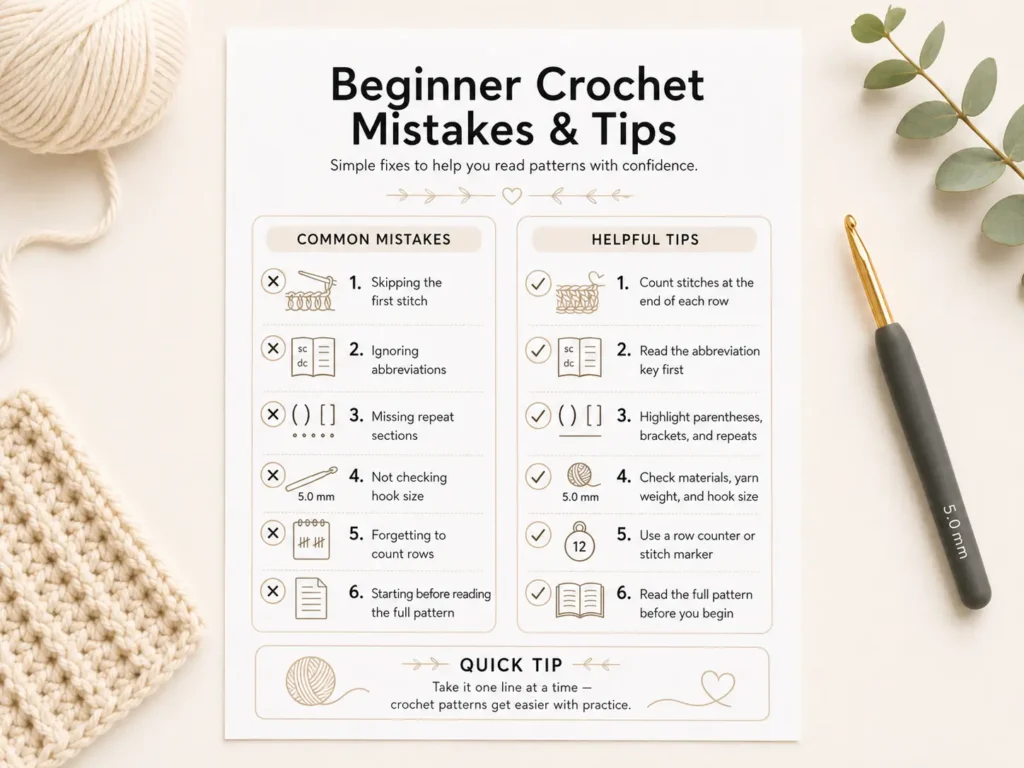
Most crochet patterns include a few common sections. Once you know what each section does, the whole pattern becomes easier to read.
1. Pattern Title
The title tells you what the project is.
For example:
Beginner Crochet Dishcloth
Easy Crochet Scarf
Simple Granny Square Blanket
The title can also give you a clue about the difficulty level or style of the project.
2. Materials
The materials section tells you what you need before you begin.
This often includes:
- yarn type
- yarn weight
- crochet hook size
- yarn needle
- scissors
- stitch markers, if needed
It is a good idea to check this section before starting. Using a very different yarn or hook size can change the size and look of your project.
3. Hook Size
The hook size tells you which crochet hook the designer recommends.
For example:
5.0 mm hook
H-8 hook
4.5 mm hook
Some patterns list both metric and US hook sizes. If your stitches are too tight or too loose, you may need to adjust your hook size.
4. Yarn Weight
Yarn weight tells you how thick the yarn should be.
Common yarn weights include:
- sport
- DK
- worsted
- bulky
- super bulky
For beginner projects, worsted weight yarn is often a good choice because it is easy to see and comfortable to work with.
5. Gauge
Gauge tells you how many stitches and rows should fit into a certain measurement.
For example:
14 sc x 16 rows = 4 x 4 inches
Gauge is really important when we talk about clothing, hats and things that need to fit. If you are just starting out. Making something simple, like a dishcloth or a scarf gauge is not as big of a deal but it is still good to know what gauge means for clothing and hats and other fitted items. Gauge is something that you should understand when you are making clothing and hats.
6. Finished Size
The finished size tells you how big the project should be when completed.
For example:
Approx. 8 x 8 inches
Approx. 60 inches long
Approx. 36 x 40 inches
This helps you know whether your project is coming out close to the intended size.
7. Notes
The notes section often includes helpful information that does not fit directly into the row-by-row instructions.
For example:
Ch 1 at the beginning of a row does not count as a stitch.
This may look like a small detail, but it can make a big difference. Pattern notes often explain rules that apply throughout the whole project, so it is worth reading them before you begin.
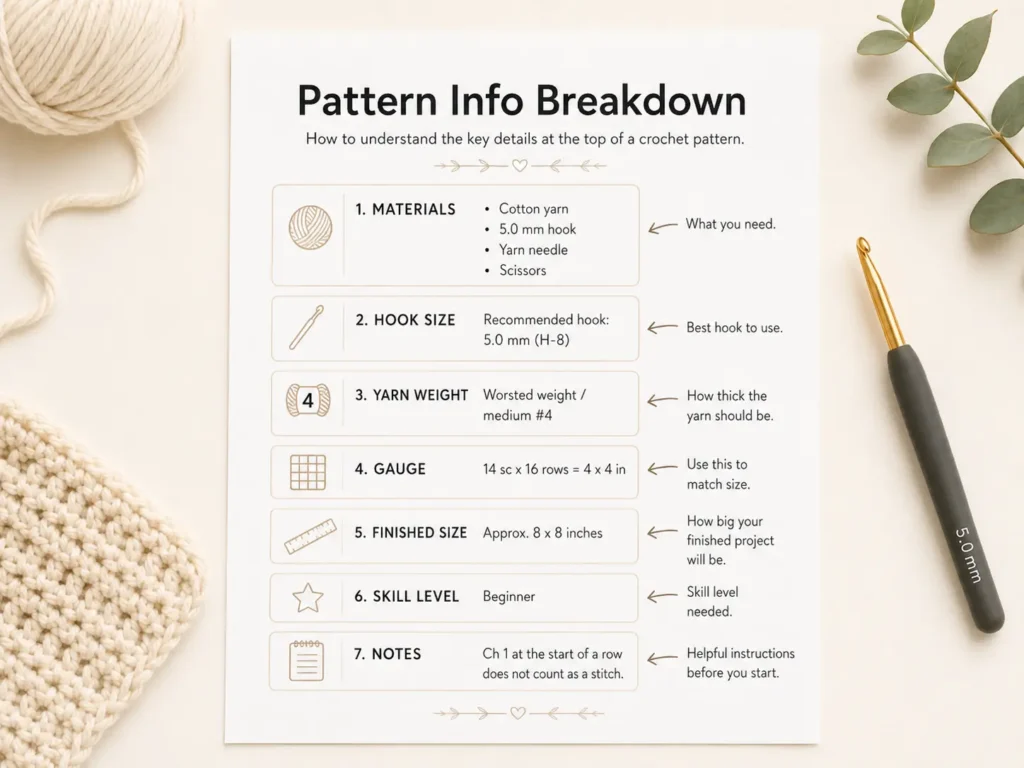
Common Crochet Abbreviations
Crochet patterns use abbreviations to keep instructions short and easier to scan.
Instead of writing “single crochet” again and again, a pattern will usually write sc.
Here are some common beginner crochet abbreviations:
| Abbreviation | Meaning |
|---|---|
| ch | chain |
| sc | single crochet |
| dc | double crochet |
| hdc | half double crochet |
| tr | treble crochet |
| sl st | slip stitch |
| st | stitch |
| sp | space |
| rep | repeat |
| sk | skip |
| inc | increase |
| dec | decrease |
| FO | fasten off |
| RS | right side |
| WS | wrong side |
You do not need to memorize every abbreviation right away. When you are new, it helps to keep a small crochet abbreviation chart nearby while you work.
Over time, the common terms will start to feel familiar.
How to Read Crochet Row Instructions
A crochet pattern is usually written row by row or round by round.
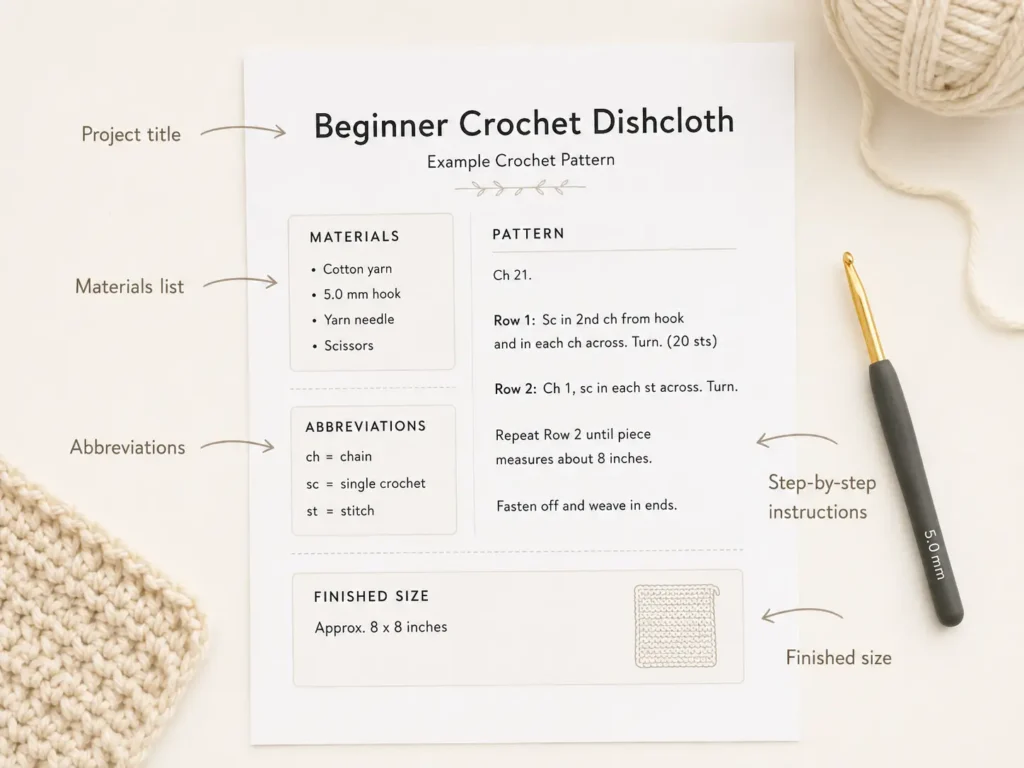
Here is a simple example:
Ch 21.
Row 1: Sc in 2nd ch from hook and in each ch across. Turn. (20 sts)
Row 2: Ch 1, sc in each st across. Turn.
Repeat Row 2 until piece measures about 8 inches.
Let’s break this down.
“Ch 21”
This means you begin by making 21 chain stitches.
The chain is usually the foundation of the project.
“Row 1”
This tells you that you are starting the first row.
The pattern then tells you exactly where to place your stitches.
“Sc in 2nd ch from hook”
This means you do not work into the chain closest to your hook. Instead, you work into the second chain from the hook.
This is a common beginner detail that can be easy to miss.
“In each ch across”
This means you continue making the same stitch into every chain across the row.
“Turn”
At the end of the row, you turn your work so you can crochet back in the other direction.
“(20 sts)”
This tells you how many stitches you should have at the end of the row.
In this example, you should have 20 stitches.
This number is very useful. If your count is different, it is better to notice early instead of several rows later.
What Do Parentheses, Brackets, and Repeats Mean?
This is one of the most confusing parts for beginners, but it becomes simple with practice.
Crochet patterns use symbols like parentheses, brackets, and asterisks to group instructions or show repeats.
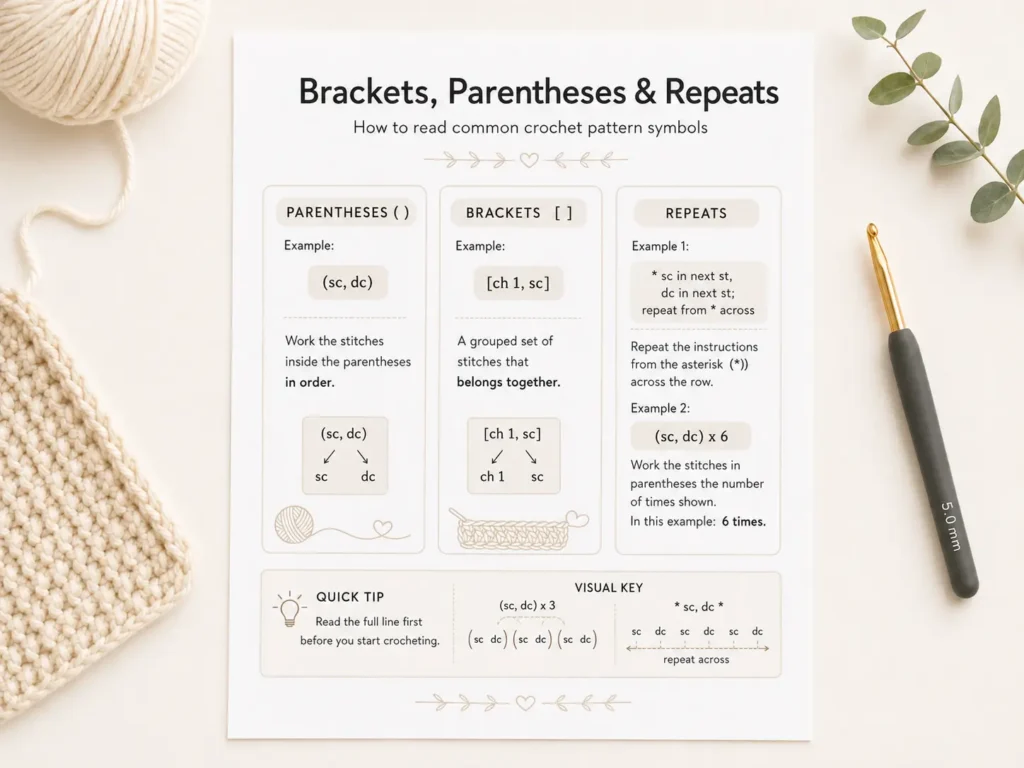
Parentheses in Crochet Patterns
Parentheses usually group stitches together.
Example:
(sc, dc)
This means you work a single crochet and a double crochet as instructed by the pattern.
Sometimes the pattern may say:
(sc, dc) x 6
This means you repeat the group six times.
So you would work:
sc, dc, sc, dc, sc, dc, sc, dc, sc, dc, sc, dc
The exact placement depends on the full instruction, but the idea is that the group inside the parentheses is repeated.
Brackets in Crochet Patterns
Brackets are also used to group instructions.
Example:
[ch 1, sc]
This means the chain 1 and single crochet belong together as one group of instructions.
Brackets are often used when the pattern has several steps that repeat together.
Asterisks and Repeats
Asterisks show where a repeated section begins.
Example:
* sc in next st, dc in next st; repeat from * across
This means you start at the asterisk and repeat those instructions across the row.
So you would repeat:
sc in next stitch, dc in next stitch
again and again until you reach the end of the row.
When you see the word repeat, slow down and read the full line before crocheting. This helps you avoid missing part of the instruction.
A Simple Way to Read Any Crochet Pattern
When you open a new crochet pattern, do not jump straight into the first row.
Use this simple order:
1. Read the title and skill level
Check what the project is and whether it is suitable for beginners.
2. Check the materials
Make sure you have the right yarn, hook, and basic tools.
3. Read the notes
This section often includes important details about turning chains, stitch counts, or special instructions.
4. Look at the abbreviations
Check the stitches used in the pattern. If there are stitches you do not know yet, learn those before starting.
5. Read the first few rows
Do not start immediately. Read the first several lines so you understand the rhythm of the pattern.
6. Crochet slowly and count often
Beginners often make mistakes when they move too quickly. Counting stitches at the end of each row can save a lot of time.
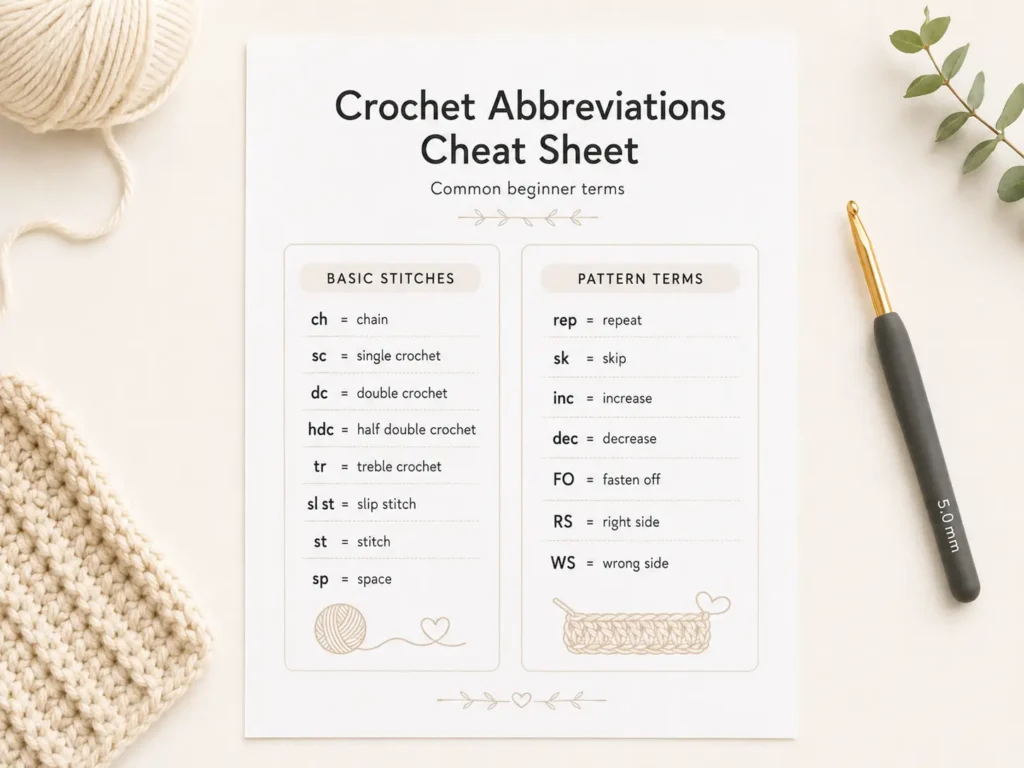
Common Beginner Mistakes When Reading Crochet Patterns
Everyone makes mistakes when learning to read patterns. That is normal.
Here are some of the most common ones.
Skipping the first stitch
This happens a lot, especially after turning your work. The first stitch can be easy to miss.
Ignoring the abbreviation key
Not every pattern uses abbreviations in exactly the same way. Always check the abbreviation section.
Missing repeat sections
Repeats can be easy to overlook, especially when a pattern uses asterisks, brackets, or parentheses.
Not checking the hook size
A different hook can change the size and texture of the project.
Forgetting to count rows
If you lose track of your rows, your project may end up shorter, longer, or uneven.
Starting before reading the full pattern
It is tempting to begin right away, but reading the pattern first helps you avoid surprises later.
Helpful Tips for Beginners
Here are a few small habits that make crochet patterns much easier to follow.
Keep a crochet abbreviation chart nearby
This is very helpful when you are still learning the basic terms.
Use a row counter
A row counter can help you stay organized, especially for scarves, blankets, and repeating patterns.
Highlight repeats
If you print the pattern, you can highlight parentheses, brackets, or repeat sections before starting.
Count stitches at the end of each row
This is one of the best beginner habits. It helps you catch mistakes early.
Read one line at a time
Do not worry about the whole pattern at once. Focus on the current row or instruction.
Take breaks
If a pattern starts to feel confusing, step away for a few minutes and come back with fresh eyes.
Example: Reading a Short Crochet Pattern
Here is a simple example:
Ch 21.
Row 1: Sc in 2nd ch from hook and in each ch across. Turn. (20 sts)
Row 2: Ch 1, sc in each st across. Turn.
Repeat Row 2 until piece measures about 8 inches.
Fasten off and weave in ends.
This pattern is asking you to:
- Make 21 chains.
- Work single crochet stitches across the first row.
- Turn your work.
- Chain 1 at the beginning of the next row.
- Single crochet across each row.
- Repeat until the piece is about 8 inches.
- Finish the yarn and weave in the ends.
Once you understand the abbreviations, this short pattern becomes much easier to follow.
Final Thoughts
Learning how to read a crochet pattern takes a little patience, but it is not as difficult as it looks at first.
Start with simple beginner patterns that use basic stitches. Keep an abbreviation chart nearby, count your stitches often, and read each instruction slowly.
The more patterns you read, the more familiar the structure becomes.
At first, you may need to pause and check every abbreviation. That is completely normal. With practice, you will start to recognize the same terms, repeats, and instructions again and again.
Crochet patterns are like a map. Once you understand the signs, they can guide you through the whole project one step at a time.
FAQ
What does “ch” mean in a crochet pattern?
Ch means chain. Chain stitches are often used at the beginning of a project or at the start of a new row.
What does “sc” mean in crochet?
Sc means single crochet. It is one of the most common basic crochet stitches, especially in beginner patterns.
What does “turn” mean in a crochet pattern?
Turn means you turn your crochet work around so you can begin the next row in the opposite direction.
What does “repeat from * across” mean?
It means you go back to the instruction marked with an asterisk and repeat that section across the row.
Should beginners read the whole crochet pattern before starting?
Yes. Reading the full pattern first helps you understand the materials, notes, repeats, and stitch instructions before you begin crocheting.